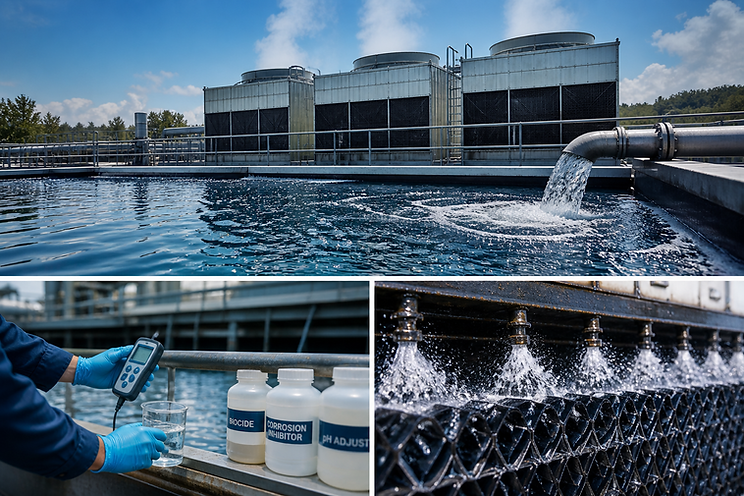
Cooling Tower Ongoing Treatment
Cooling tower systems are highly susceptible to scaling, corrosion, and biological fouling due to constant evaporation and concentration of dissolved solids. Our cooling tower treatment programs are designed to control water chemistry through the use of targeted chemical applications, conductivity-based control strategies, and routine monitoring. We manage cycles of concentration, stabilize scaling potential, and implement biocide programs to control algae, bacteria, and biofilm formation. Through consistent testing, system adjustments, and performance tracking, we ensure optimal heat transfer efficiency, reduced water consumption, and long-term protection of system components.
Traditional Treatment Strategies
Liquid chemical feed systems represent the most widely used and established method of cooling tower water treatment. These systems utilize multiple liquid products—typically including a corrosion/scale inhibitor, an oxidizing biocide, and a non-oxidizing biocide—stored in dedicated tanks and metered into the system through calibrated feed pumps.
Control of these systems is achieved through a combination of conductivity-based controllers, timers, and system-specific adjustments, allowing for effective management of scaling potential, corrosion control, and microbiological activity. When properly maintained and monitored, liquid treatment programs provide reliable and consistent protection for cooling tower systems.
Total Services Group designs, installs, and maintains liquid chemical feed systems tailored to each facility. Our approach ensures proper chemical selection, accurate feed control, and ongoing monitoring to maintain system performance and protect equipment over the long term.


Dry Feed Chemical Treatment Systems
(Modern Approach)
Dry feed chemical systems offer a more streamlined and modern approach to water treatment by utilizing concentrated chemistry that is activated and introduced into the system without the need for bulk liquid storage. These systems are designed to deliver precise, controlled dosing based on system demand, often tied directly to makeup water, flow, or conductivity.
By eliminating large liquid storage tanks, dry feed systems can reduce handling requirements, simplify system layout, and provide a more compact footprint within the mechanical space. The controlled activation and feed of chemistry allows for consistent treatment levels while maintaining effective control of scale, corrosion, and biological growth.
Total Services Group provides dry feed system design, installation, and service, ensuring the system is properly integrated and aligned with operational requirements. These systems represent a modern evolution in water treatment strategy and are often selected where efficiency, space, and streamlined operation are key considerations.
Engineering the Right Approach
Total Services Group supports both liquid and dry feed treatment strategies and engineers each program based on the specific needs of the facility, system design, and operational goals. Factors such as water quality, system size, space constraints, maintenance preferences, and performance objectives all play a role in determining the most appropriate solution.
Our focus is not on applying a one-size-fits-all approach, but on delivering the right system and treatment program to ensure long-term performance, reliability, and protection of your water systems.